If you manage a non-domestic building, or the common parts of a block of flats, built before 2000, you're likely to need an asbestos register: the live record of where the asbestos is and what condition it's in. Here's what it must include, who keeps it and how to keep it current, summarised from HSE guidance.
Before you rely on this: it's a plain-English summary of the Health and Safety Executive's guidance on the duty to manage asbestos as it stood in October 2026. The duty comes from the Control of Asbestos Regulations, which apply in Great Britain. It isn't legal or professional advice, and asbestos surveys should be done by competent surveyors. The official pages are listed at the end.
What an asbestos register is
An asbestos register is the record of the known and presumed asbestos-containing materials (ACMs) in a building: where they are and what condition they're in. HSE describes it as a live document that must always contain current information, and a key part of the building's asbestos management plan. It can be kept on paper or electronically.
It's usually built from an asbestos management survey. HSE says the main aim of a management survey is to let the dutyholder produce the asbestos register and the asbestos management plan.
Who has to keep one
The duty to manage asbestos is part of the Control of Asbestos Regulations. It covers all non-domestic premises, such as factories, offices and shops, and the common parts of multi-occupancy domestic premises, such as purpose-built flats.
The person with the duty, the dutyholder, could be the building owner, the landlord, or the person or organisation with clear responsibility for the building's maintenance or repair. In a block of flats, that's whoever is responsible for maintaining or repairing the common parts.
HSE says that if a building was built or refurbished before 2000, you should assume there is asbestos in it. Unless there's strong evidence that a material doesn't contain asbestos, you must presume it does.
What the register must include
HSE says the register should include, as a minimum:
- all known and presumed ACMs in the building
- the type of each ACM
- how much asbestos there is and its condition, including the dates of the original and the last inspection
- each ACM's potential to release fibres (the material assessment) and how likely it is to be disturbed during the day-to-day running of the building (the priority assessment)
- where asbestos is presumed to be, if the surveyor couldn't get into an area.
HSE adds that it helps to record, for each ACM:
- photographs, to confirm the location and for routine condition checks
- actions and due dates
- evidence that the actions were completed
- when the next condition assessment is due.
The register must also include a risk assessment, to help identify and prioritise any ACMs that need remedial action. It takes into account things like how easy the ACMs are to reach, how many people use the area, whether people work near them in a way that could disturb them, and whether maintenance or refurbishment is likely there.
Keeping it current
HSE says to update the register at least once a year as part of the asbestos management review, or sooner if anything changes the risk. In practice that means:
- inspecting ACMs regularly and updating the record if they've deteriorated
- recording when ACMs are removed or repaired
- adding new findings when more areas are surveyed or sampled
- changing the risk assessment if the likelihood of disturbance changes, for example when a room's use changes or maintenance is planned.
The asbestos management plan itself must be reviewed every 12 months, or sooner if necessary.
Who needs to see it
The dutyholder must give information on the location and condition of ACMs to anyone who may work on or disturb them, including the emergency services. In practice, that means the register needs to be easy to reach for the contractors and maintenance teams working in the building.
A management survey isn't enough before refurbishment or demolition. That needs a refurbishment or demolition survey, to find asbestos hidden in the building fabric, and asbestos must be removed, as far as reasonably practicable, before major refurbishment or demolition.
Where it fits with a building's other records
An asbestos register is one of many records a building builds up over its life, and building records management covers the rest. For high-rise residential buildings in England, asbestos removal across several floors is also one of the building works the Building Safety Regulator asks about in the key building information. For the wider rules on those buildings, there's a plain-English summary of the Building Safety Act.
Where Building Search fits
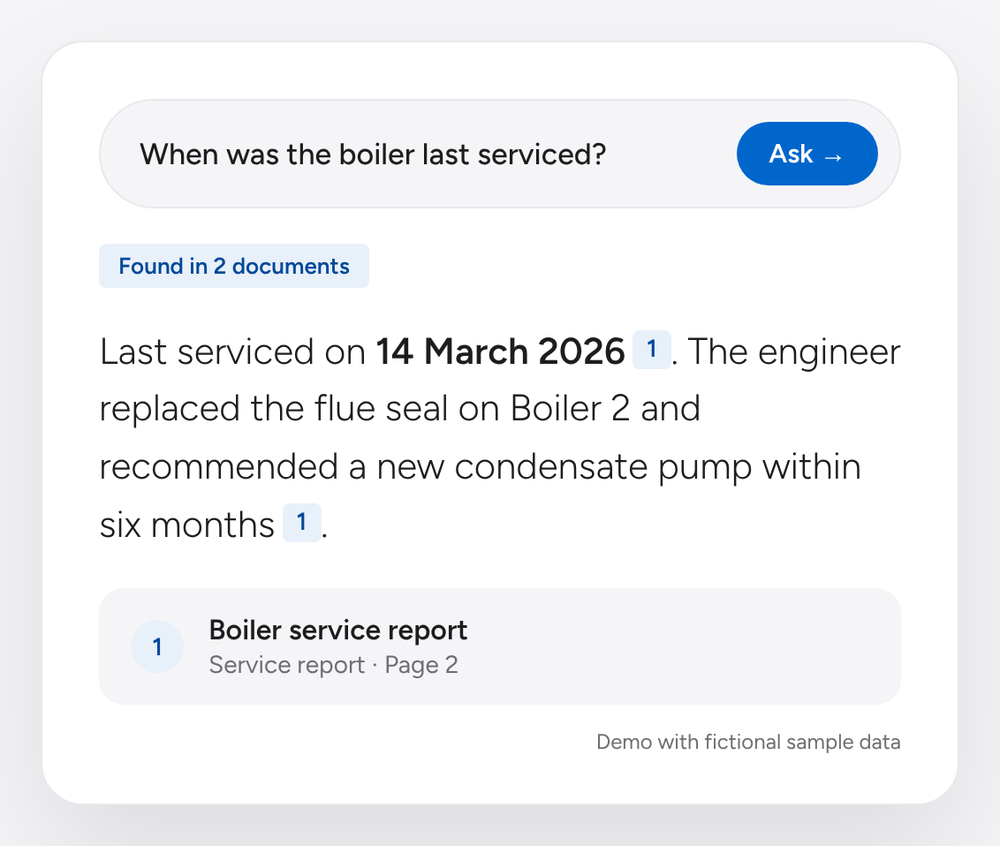
Asbestos surveys are long documents, and the answer someone needs, such as whether a particular ceiling void was inspected, is usually on one page. Building Search makes a building's surveys, registers and other files searchable, and shows the document and exact page each answer came from. It doesn't replace the register or a competent surveyor, and before any work that could disturb asbestos, check the register itself. You can try the interactive demo, which uses fictional sample data.
Looking after several buildings' files? I'll send you a free one-page plan showing what a search page for one of your buildings would look like and what it would cost. See how Building Search works.
Questions people actually ask
What is an asbestos register?
It's the live record of the known and presumed asbestos-containing materials in a building: where they are, what type they are and what condition they're in. It's a key part of the building's asbestos management plan, and it can be on paper or electronic.
What information does an asbestos register include?
As a minimum, HSE says: every known and presumed ACM, its type, how much there is and its condition with inspection dates, a material assessment and a priority assessment, and where asbestos is presumed in areas the surveyor couldn't reach. It must also include a risk assessment.
Who is responsible for the asbestos register?
The dutyholder under the duty to manage asbestos: the building owner, the landlord, or whoever has clear responsibility for the building's maintenance or repair.
How often should an asbestos register be updated?
HSE says at least once a year, as part of the asbestos management review, or sooner if anything changes the risk, such as deterioration, removal or repair, new survey findings or a change in how an area is used.
Do blocks of flats need an asbestos register?
The duty to manage asbestos covers the common parts of multi-occupancy domestic premises, such as purpose-built flats. Whoever is responsible for maintaining or repairing those common parts has the duty for them.
Official guidance
- The duty to manage asbestos in buildings: overview (Health and Safety Executive)
- Make a register and assess the risk (Health and Safety Executive)
- Arrange an asbestos survey (Health and Safety Executive)
- The Control of Asbestos Regulations 2012 (legislation.gov.uk)