The Building Safety Act 2022 reshaped how buildings in England are designed, built and managed after the Grenfell Tower fire. This is a short, plain-English summary of what it does, with links to more detailed explainers on the parts that matter most to people who manage residential buildings.
Before you rely on this: it's a plain-English summary of GOV.UK guidance as it stood in October 2026, and it applies to England. It isn't legal advice. The official pages are listed at the end, and they're the ones to check.
What the Act does
The Building Safety Act received Royal Assent on 28 April 2022. The government describes it as giving residents and homeowners more rights, powers and protections, protecting qualifying leaseholders from the costs of fixing historical building safety defects, and overhauling how residential buildings are constructed, maintained and made safe. Much of the detail is set out in secondary legislation made under the Act.
It created three new bodies:
- the Building Safety Regulator (BSR), which oversees the safety and performance of all buildings, with a special focus on high-rise buildings
- a national regulator for construction products, to oversee the regulation of construction products
- the New Homes Ombudsman, so owners of new-build homes can escalate complaints.
Higher-risk buildings
Many of the Act's strictest duties apply to higher-risk buildings. A higher-risk building has at least 7 storeys or is at least 18 metres high, and has at least 2 residential units or is a hospital or care home. A higher-risk building with at least 2 residential units must be registered with BSR before anyone lives there, and when you register it you give BSR its key building information.
Design and construction
For higher-risk buildings, BSR is the building control authority. The client must get building control approval from BSR before building work starts on a new higher-risk building, and before most building work on an existing one. Carrying out work without the required approval is a criminal offence. When the work is finished, the client applies for a completion certificate, which is needed before a residential higher-risk building can be registered. These approval stages are often called gateways.
Once people live there
Responsibility passes to the accountable persons: whoever owns the common parts or has a legal obligation to repair them, led by one principal accountable person. They're responsible for assessing and managing the risks of fire spread and structural failure. Among their duties, they must:
- register the building with BSR and provide its key building information
- prepare a safety case report and send it to BSR when asked
- keep the building's golden thread of information
- report safety occurrences to BSR, through a mandatory occurrence reporting system
- carry out duties under a residents' engagement strategy
- provide building information to the people entitled to it.
Accountable persons can employ a managing agent to carry out duties for them, but the legal accountability stays with them. The government says those who don't meet their obligations may face criminal charges.
Residents and leaseholders
Residents of high-rise buildings get more say in how their building is kept safe. They can raise safety concerns with the accountable persons, who have a duty to listen, and with BSR if they feel they're being ignored. Qualifying leaseholders are protected from the cost of removing or remediating cladding, which in most cases means buildings over five storeys or 11 metres tall, and have protections from other historical defect costs. The time all homeowners have to claim compensation for substandard construction work went up from 6 to 15 years.
The explainers in this series
- The golden thread of information: what has to be kept for a higher-risk building, who keeps it and how.
- The building safety case report: who writes it, what goes in it and when to update it.
- Key building information: a checklist of the structure and fire safety details BSR asks for at registration.
- O&M manuals: what they contain and how they fit with the health and safety file and fire safety information.
- Building records management: the records a residential building builds up, and how to keep them findable.
Where Building Search fits
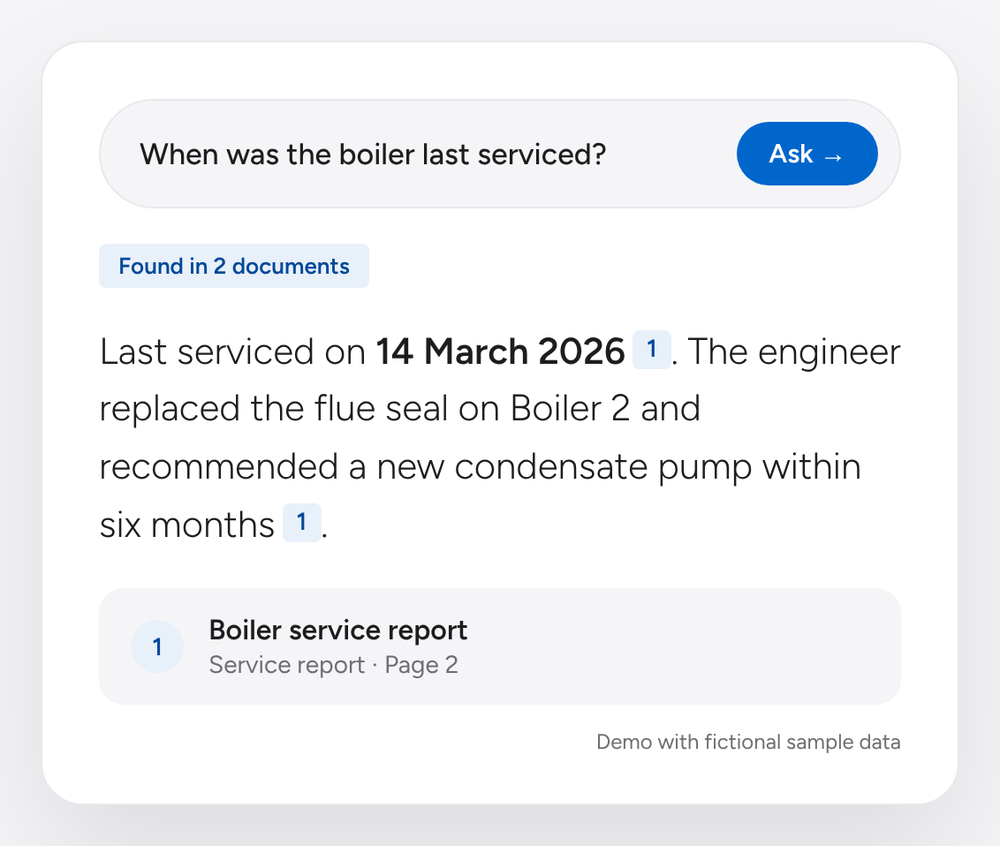
A lot of what the Act asks for depends on being able to find a building's information quickly. I built Building Search to answer plain questions from a building's own files, with the document and exact page each answer came from. It doesn't make anyone compliant on its own. It makes the information you already hold quicker to find and check. There's an interactive demo with fictional sample data.
Looking after several buildings' files? I'll send you a free one-page plan showing what a search page for one of your buildings would look like and what it would cost. See how Building Search works.
Questions people actually ask
What is the Building Safety Act 2022 in simple terms?
It's the law that reformed building safety in England after the Grenfell Tower fire. It created the Building Safety Regulator, set stricter rules for designing, building and managing higher-risk buildings, gave residents more say, and protected qualifying leaseholders from many historical defect costs.
What is a higher-risk building?
A building with at least 7 storeys or at least 18 metres high, and at least 2 residential units, or a hospital or care home. Residential higher-risk buildings must be registered with the Building Safety Regulator before people live there.
Who regulates the Building Safety Act?
The Building Safety Regulator oversees the new regime, including building control for higher-risk buildings and the duties of the people responsible for occupied high-rise residential buildings.
What is an accountable person?
The organisation or individual that owns the common parts of a high-rise residential building, or has a legal obligation to repair them. Each building has one principal accountable person, who leads on duties such as the safety case report and the golden thread.
Official guidance
- The Building Safety Act (GOV.UK)
- Building Safety Act 2022 (legislation.gov.uk)
- Building control approval for higher-risk buildings (Building Safety Regulator, GOV.UK)
- Safety in high-rise residential buildings: accountable persons (Building Safety Regulator, GOV.UK)