If you're responsible for a high-rise residential building in England, the Building Safety Act expects its safety information to live in one digital, up-to-date record that the right people can reach. That record is the golden thread. Here's what it is, which buildings it covers, who holds it and what goes in it, in plain English.
Before you rely on this: it's a plain-English summary of the Building Safety Regulator's guidance as it stood in October 2026, and it applies to England. It isn't legal advice. The official pages are listed at the end, and they're the ones to check.
What the golden thread of information is
The golden thread is the information about a building that the people responsible for it need in order to understand the building and keep it, and the people living in it, safe. The term comes from Dame Judith Hackitt's review after the Grenfell Tower fire, Building a Safer Future, which recommended a golden thread of good-quality information that follows a building from its design through its whole life. For where it sits in the wider Act, there's a plain-English summary of the Building Safety Act.
The Building Safety Act 2022 turned that recommendation into legal duties. In practice it means three things: the information has to exist, it has to be kept up to date, and the right people have to be able to find it and use it. The government decided it must be stored digitally, although it can sit across more than one system.
Which buildings it applies to
The golden thread applies to higher-risk buildings. A higher-risk building has at least:
- 7 storeys, or a height of at least 18 metres, and
- 2 residential units, or it is a hospital or a care home.
During design and construction, the duties cover all of those buildings. Once a building is occupied, the duties below fall on the people responsible for high-rise residential buildings: those with at least 7 storeys or 18 metres and at least 2 residential units. A higher-risk building with at least 2 residential units must be registered with the Building Safety Regulator (BSR) before anyone lives there, and registering includes giving BSR the building's key building information.
Who is responsible for it
During design and construction
The client must keep information that describes the building and shows how it complies with building regulations, and must provide a digital record-keeping system with version control, so anyone using it can see what changed. The principal designer keeps the design information up to date, and the principal contractor uses the client's system to keep the building information current.
When the work is finished, the client hands the information over: to the principal accountable person or accountable person for a high-rise residential building, and the relevant fire safety information to the Responsible Person for any non-residential parts. Whoever receives it must confirm they have it and that it's in a format they can use.
Once people live there
Responsibility passes to the accountable persons. An accountable person is the organisation or individual that owns the common parts of the building, or has a legal obligation to repair them: the structure and exterior, corridors, lobbies and staircases. That can be a freeholder, landlord, management company, resident management company, right to manage company or commonhold association.
Every building has one principal accountable person. If there's only one accountable person, they're it. If there are several, it's whoever owns, or must repair, the structure and exterior. The principal accountable person must make sure the others understand the policies for keeping and storing the building's information.
One point that matters to managing agents: accountable persons can employ an agent to carry out duties for them, but they can't hand over the legal responsibility. A management company working under a contract to maintain a building isn't an accountable person. One that a lease requires to repair the common parts is the accountable person for those parts.
What has to go in it
For an occupied high-rise residential building, accountable persons must keep the building's:
- health and safety file
- safety case report
- residents' engagement strategy
- mandatory occurrence reporting system.
Where they exist, the guidance says you should also keep:
- information about refurbishments to the building
- information from previous owners, including inspection reports and maintenance records
- the standard the building was built to, such as which building regulations applied at the time.
You must also be able to show how you assess and manage building safety risks, including the spread of fire and structural failure, show that you know how to update and maintain the information, and understand the fire strategy for the parts of the building you're responsible for.
During design and construction, the record also holds what was prepared for building control approval, including the drawings and plans, competence declaration, construction control plan, change control plan and log, building regulations compliance statement, and the fire and emergency file.
How it has to be kept
The guidance sets out how the information must be managed and stored. It must be:
- kept digitally
- secure from unauthorised access
- available when someone needs it
- presented in a way someone can use
- the building's single source of truth
- accessible, in a simple format that's easy to understand and written in plain English
- compliant with data protection law (GDPR).
Who can ask to see it
Accountable persons must provide the building information on request to the Building Safety Regulator, to other accountable persons for the building, and to residents or owners of residential units in it. Where a building has more than one accountable person, each must share their golden thread information with the others. When an accountable person or principal accountable person stops being responsible for a building, they must pass the information they held to whoever takes over.
Where it gets hard in practice
The rules say what to keep. They don't make it easy to find. In most buildings the information already exists, but it's spread across drawings, operation and maintenance manuals, service reports, certificates and warranties, often on a shared drive and in a mix of searchable files and scans. "Available when someone needs it" and "a single source of truth" are the two requirements that tend to fall down: the document is in there somewhere, but nobody can lay a hand on it quickly. A few habits help, and they're covered in building records management.
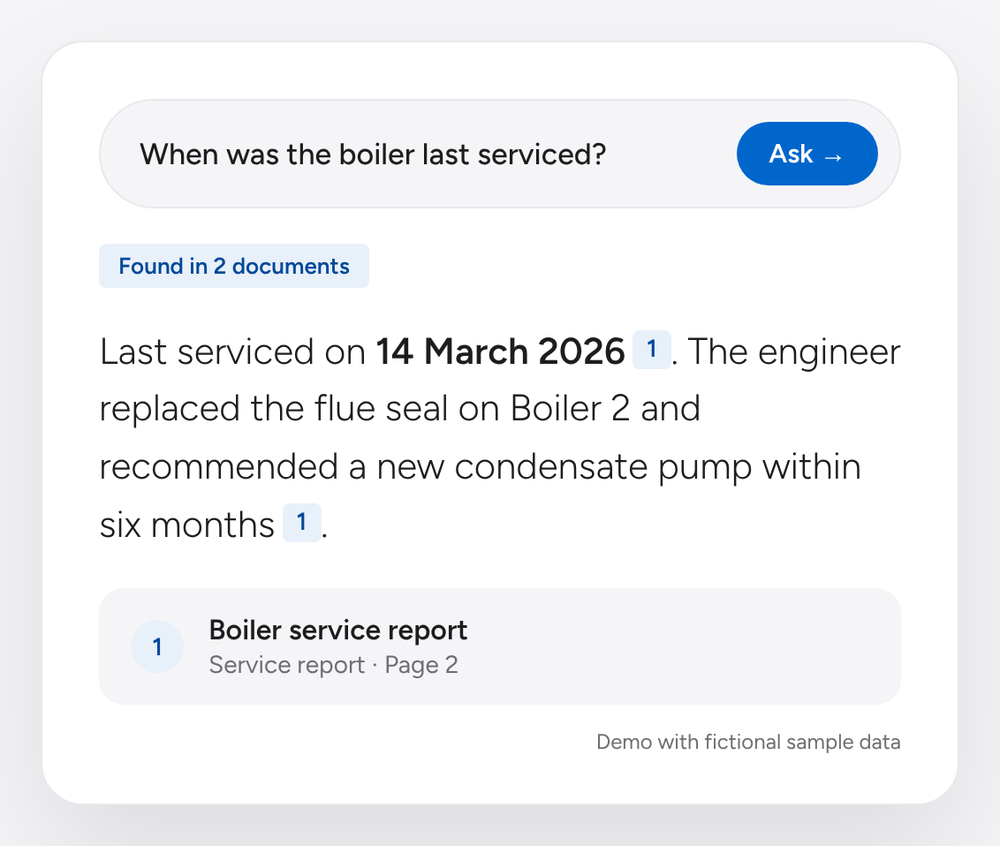
That's the problem I built Building Search for: a private search page over one building's files that answers a plain question with the document and the exact page the answer came from. It doesn't make anyone compliant on its own, and it doesn't replace the record-keeping the Act requires. It makes the information you already hold quicker to find and check. There's an interactive demo with fictional sample data if you'd like to see it working.
Looking after several buildings' files? I'll send you a free one-page plan showing what a search page for one of your buildings would look like and what it would cost. See how Building Search works.
Questions people actually ask
What is the golden thread in the Building Safety Act?
It's the information about a higher-risk building that the people responsible for it need to understand the building and keep it and its residents safe. The Act requires it to be kept digitally, kept up to date and made available to the people who need it.
Does the golden thread have to be digital?
Yes. The Building Safety Regulator's guidance says it must be kept digitally. It can be held on more than one system, but it still has to work as the building's single source of truth and be secure, available and easy to use.
Who is responsible for the golden thread?
During design and construction, the client, working with the principal designer and principal contractor. Once residents live in a high-rise residential building, the accountable persons are responsible, with the principal accountable person taking the lead where there's more than one.
Does the golden thread apply to my building?
It applies to higher-risk buildings in England: at least 7 storeys or 18 metres high, with at least 2 residential units, or a hospital or care home during design and construction. If you're not sure whether a building qualifies, the Building Safety Regulator publishes guidance on the criteria.
Can a managing agent be the accountable person?
Not usually. An accountable person owns the common parts or has a legal obligation to repair them. A managing agent can carry out duties on their behalf, but the legal responsibility stays with the accountable person. A management company that a lease makes responsible for repairing the common parts is the accountable person for those parts.
Official guidance
- Keeping information about a higher-risk building: the golden thread (Building Safety Regulator, GOV.UK)
- Safety in high-rise residential buildings: accountable persons (Building Safety Regulator, GOV.UK)
- High-rise residential building information accountable persons must provide (Building Safety Regulator, GOV.UK)
- Understanding the golden thread (Building Safety Regulator, Making Buildings Safer)