A residential building collects records constantly: risk assessments, service reports, certificates, surveys and inspection logs. Keeping them isn't the hard part. Finding the right page when someone asks is. Here's what tends to build up, which checks the law requires, and how to keep it all findable.
Before you rely on this: the legal duties are summarised from GOV.UK guidance as it stood in October 2026, and they apply to England. It isn't legal advice. The official pages are listed at the end, and they're the ones to check.
What builds up in a building's records
For a typical block of flats, the files usually include:
- fire risk assessments and their action plans
- fire door checks and surveys
- fire alarm, emergency lighting and sprinkler service records
- electrical installation condition reports
- gas safety and boiler service records
- lift inspection and maintenance reports
- water hygiene (legionella) risk assessments
- asbestos surveys and registers
- structural and external wall surveys
- O&M manuals, as-built drawings and the health and safety file from construction
- warranties, guarantees and insurance documents
- records of past refurbishment and remediation work.
Which of these apply depends on the building, its services and its height, and the same is true of the legal requirements.
Checks the law requires, and the records they create
In England, the Fire Safety (England) Regulations 2022, in force since 23 January 2023, gave responsible persons specific duties in residential buildings with two or more sets of domestic premises:
- In all of those buildings: give residents fire safety instructions, and information about the importance of fire doors.
- Where the building has storeys above 11 metres: check flat entrance doors every year and the fire doors in the common parts every quarter.
- In high-rise residential buildings: give the local fire and rescue service up-to-date electronic floor plans and information about the external wall system; keep a secure information box on site with floor plans and the responsible person's contact details; install wayfinding signage; and check lifts for firefighters, evacuation lifts and other key firefighting equipment every month, reporting faults that can't be fixed within 24 hours to the fire and rescue service, and recording the results and making them available to residents.
For higher-risk buildings, the Building Safety Act also requires accountable persons to keep the building's golden thread of information and to prepare a safety case report. There's a plain-English summary of the Building Safety Act if you need the bigger picture.
Five habits that keep records findable
- One place per building. Keep each building's records together, in one shared location the right people can reach, rather than split across inboxes and personal drives. For higher-risk buildings, the golden thread rules ask for exactly this: a single source of truth.
- Searchable, not just stored. A scanned PDF is only findable if its text can be searched. Make scans searchable when they arrive.
- Clear names and dates. Name each file with the building, the document type and the date, so the latest version is obvious.
- Current version first, history kept. Keep superseded reports, marked as superseded, because the history matters, but make the current one easy to spot.
- Track actions, not just reports. A fire risk assessment or survey usually comes with actions. Record when each one was completed, so the report and its follow-up stay together.
Where Building Search fits
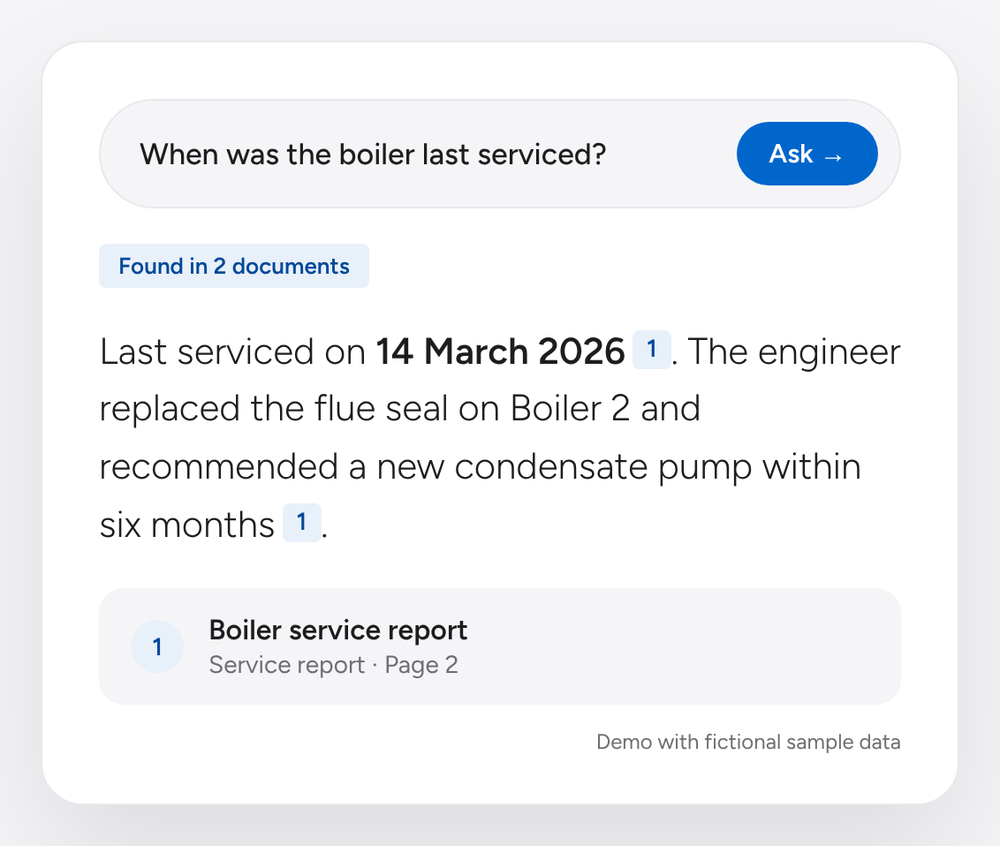
Even well-kept records are slow to search when the answer is a line on page 40 of a service report. Building Search builds a private search page for one building's files, so you can ask a plain question, such as when the emergency lighting was last tested, and get the answer with the document and exact page it came from. It also builds an equipment register from the documents, with the last record and the next date due. It doesn't replace your record-keeping, and it doesn't make you compliant on its own. You can try the interactive demo, which uses fictional sample data.
Looking after several buildings' files? I'll send you a free one-page plan showing what a search page for one of your buildings would look like and what it would cost. See how Building Search works.
Questions people actually ask
What is building records management?
It's keeping a building's documents, such as risk assessments, certificates, service reports, surveys and manuals, organised, current and easy to find, so the people responsible for the building can answer questions about it and show what's been done.
What records should a block manager keep?
It depends on the building, but commonly fire risk assessments, fire door checks, fire alarm and emergency lighting records, electrical and gas safety records, lift inspections, legionella and asbestos records, surveys, O&M manuals, warranties, insurance documents and records of past building work.
How often must fire doors be checked in a block of flats?
Under the Fire Safety (England) Regulations 2022, in residential buildings with storeys above 11 metres, the responsible person must check fire doors in the common parts every quarter and flat entrance doors every year.
Do building records have to be digital?
For higher-risk buildings in England, the golden thread of information must be kept digitally. For other buildings, check what the relevant regulations, your contracts and your insurers require. Digital, searchable copies make records far easier to use either way.
Official guidance
- Fire Safety (England) Regulations 2022: overview fact sheet (Home Office, GOV.UK)
- Fire Safety (England) Regulations 2022: fire doors fact sheet (Home Office, GOV.UK)
- Keeping information about a higher-risk building: the golden thread (Building Safety Regulator, GOV.UK)
- Preparing a safety case report (Building Safety Regulator, GOV.UK)