Every occupied high-rise residential building in England needs a safety case report: the document that sets out the building's fire and structural risks and how they're being managed. Here's who writes it, what goes in it and when it has to change, summarised from the Building Safety Regulator's guidance.
Before you rely on this: it's a plain-English summary of the Building Safety Regulator's guidance as it stood in October 2026, and it applies to England. It isn't legal advice. The official pages are listed at the end, and they're the ones to check.
What a building safety case report is
A safety case report sets out the building safety risks of a high-rise residential building and how they are being managed. Under the Building Safety Act 2022, "building safety risks" means two things: the spread of fire or smoke in the building, and structural failure of the building.
It applies to high-rise residential buildings: those with at least 7 storeys, or at least 18 metres high, and at least 2 residential units. These are higher-risk buildings under the Act, and they must be registered with the Building Safety Regulator (BSR) before people live there.
The report is a summary. Behind it sits the evidence: risk assessments, surveys, inspection records and maintenance history. That evidence is part of the building's golden thread of information, which accountable persons must keep. For how the safety case fits with the rest of the Act, there's a plain-English summary of the Building Safety Act.
Who writes it, and when
The principal accountable person (PAP) prepares the report. BSR's guidance says to do it as soon as possible once the building is occupied, or once you become the PAP. Where a building has more than one accountable person, the report includes a summary of the risk assessments each of them has carried out.
You must send BSR a copy when it tells you to apply for a building assessment certificate, and at any other time it asks for one. Include a date, a version number or both, so the latest version is easy to identify.
What goes in it
BSR's guidance lists what the report should cover. In summary:
- Basic building information. The name, full address, the registration number beginning "HRB", build date, height, number of storeys, floor plans for each type of storey layout and the location. Also the number and type of residential units, the common parts, the resident profile, any non-residential uses, the surrounding area, and the services and utilities, including isolation points.
- The people responsible. Contact details for the PAP, the building owner if different, any other accountable persons, the responsible persons under the Fire Safety Order and any managing agents, plus how the accountable persons share information.
- Construction methods and materials. The main structural elements, construction and load-bearing methods, cladding support systems, facade and roofing materials, foundations and local ground conditions.
- Structural condition. Any history of structural problems, the surveys and inspections carried out and what they found, and how you keep the structure sound.
- Building work. Refurbishment and remediation since the building was constructed that could affect building safety risks, and any work in progress or planned.
- Fire safety measures. The fire safety standards the building was built to, the external walls, compartmentation, fire doors, smoke control, escape routes, staircases, detection and warning systems, and sprinklers or other suppression systems.
- Risk assessments. How each accountable person assessed the risks, who was involved and their competence, the significant findings, and what is being done about them.
- The emergency plan. The evacuation strategy, how it's been communicated to residents and how their needs have been taken into account, plus the facilities for the fire service.
- Safety management systems. Roles and competence, maintenance and inspection, managing change, monitoring performance, and reviewing the systems themselves.
If you couldn't find some of the information, the guidance says to explain in the report what you did to try to find it.
The evidence behind it
Much of the report draws on documents that already exist but are spread around: structural surveys, fire risk assessments, fire door surveys, inspection and maintenance records, and the details of past building work. BSR asks for evidence, for example that fire doors and door closers are regularly inspected, and for the actions from inspections and risk assessments that have been completed, with dates, and those still outstanding.
That's why the hard part is often gathering the evidence rather than writing the report. If a building's information already sits in one searchable place, the report is quicker to assemble and easier to keep current. For the structure and fire safety questions BSR asks when you register a building, see the key building information checklist.
When to update it
Update the report when things change, for example when improvement work is carried out to manage building safety risks, or when work on the building affects those risks. You must tell BSR as soon as possible if an update includes new or increased building safety risks, or further measures taken to manage them. BSR will ask for the date of the update, a brief description and the reason for it. It may ask for the updated report, and if it decides to review it, there's a charge under BSR's charging scheme.
Where Building Search fits
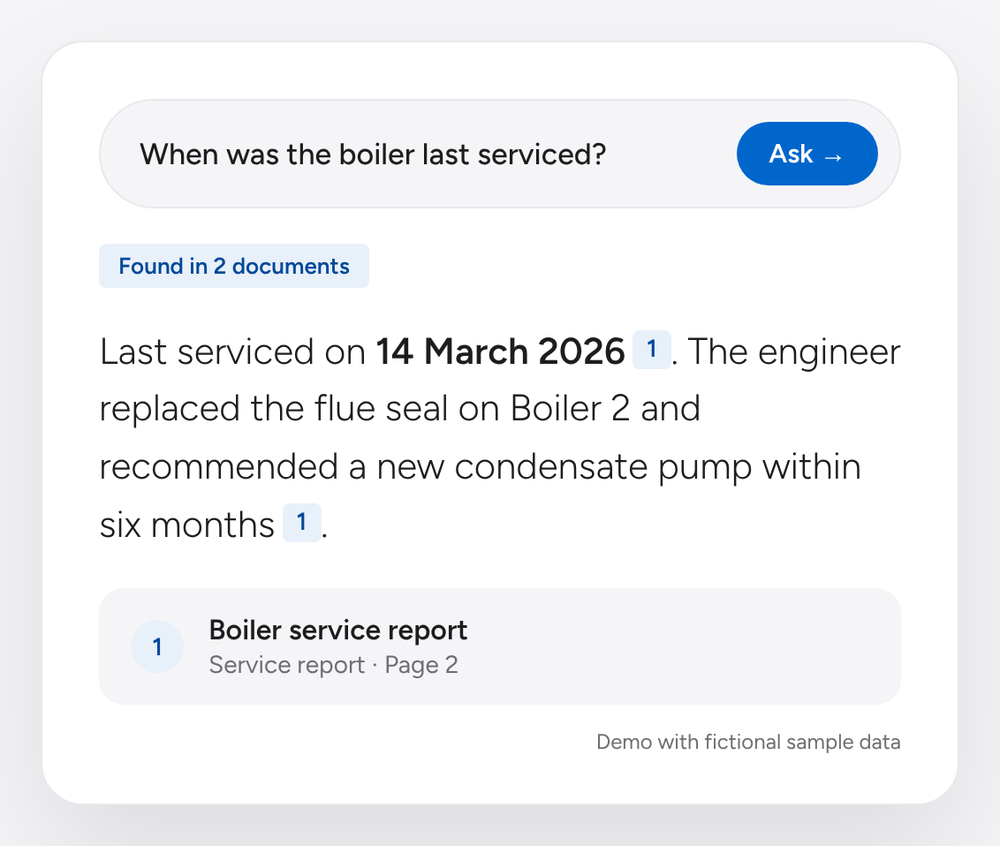
I built Building Search to answer plain questions from a building's own files, such as when the fire doors were last inspected or what the last structural survey found, with the document and the exact page each answer came from. It doesn't write a safety case report, and it doesn't make anyone compliant. It makes the evidence you already hold quicker to find and check. There's an interactive demo with fictional sample data if you'd like to see it working.
Looking after several buildings' files? I'll send you a free one-page plan showing what a search page for one of your buildings would look like and what it would cost. See how Building Search works.
Questions people actually ask
What is a building safety case?
It's how the accountable persons for a high-rise residential building show that they're assessing and managing the risks of fire spread and structural failure. The safety case report is the document that summarises it, prepared by the principal accountable person for the Building Safety Regulator.
Who is responsible for the safety case report?
The principal accountable person prepares it. Where a building has more than one accountable person, the report includes a summary of the risk assessments each of them has carried out for the parts of the building they're responsible for.
When do you send the safety case report to the Building Safety Regulator?
When BSR tells you to apply for a building assessment certificate, and at any other time BSR asks for it. You must also tell BSR as soon as possible if you update the report to include new or increased building safety risks, or further measures to manage them.
How often should a safety case report be updated?
BSR's guidance ties updates to change rather than to a fixed interval: update it when improvement work is carried out to manage building safety risks, or when work on the building affects those risks.
Does my building need a safety case report?
If it's an occupied high-rise residential building in England, with at least 7 storeys or at least 18 metres high and at least 2 residential units, yes. Those buildings are higher-risk buildings under the Building Safety Act.
Official guidance
- Preparing a safety case report (Building Safety Regulator, GOV.UK)
- Assessing safety risks in high-rise residential buildings: a detailed guide (Building Safety Regulator, GOV.UK)
- Safety in high-rise residential buildings: accountable persons (Building Safety Regulator, GOV.UK)
- Keeping information about a higher-risk building: the golden thread (Building Safety Regulator, GOV.UK)