There's no single official fire risk assessment form you have to use, but there are free templates from GOV.UK and the fire industry, and the law is clear about what the finished record must contain. Here's where to get a template, the sections a good one includes, and what has to be written down in England since October 2023.
Before you rely on this: it's a plain-English summary of GOV.UK and Home Office guidance as it stood in October 2026, and it applies to England. It isn't legal advice. A template is a way of recording an assessment, not a substitute for one: the assessment itself should be carried out by someone competent. The official pages are listed at the end.
Fire risk assessment templates at a glance
| Question | In short |
|---|---|
| Is there an official template? | GOV.UK publishes a free 5-step checklist with a fill-in form, meant for the simplest premises |
| Is a particular format required? | No set format, but you must keep a written record of the assessment, in full, with all its findings |
| Free templates for bigger premises? | The Fire Industry Association offers free downloads of the PAS 79 pro formas |
| Blocks of flats and other housing? | BS 9792:2025 replaced PAS 79-2 in 2025 and includes a refreshed pro forma. It's a paid British Standard |
| Who fills it in? | The responsible person, or a competent person they appoint. The responsibility stays with them either way |
| Where it applies | England. The rules differ in other parts of the UK |
Where to get a free template
GOV.UK's 5-step checklist. The Home Office publishes Fire safety risk assessment: 5-step checklist, last updated in January 2025. It walks through the five steps, then gives a fill-in checklist and an action plan table. GOV.UK says it's meant for the simplest premises, and recommends reading the relevant guide for your type of premises first.
GOV.UK guides by premises type. There are separate Home Office guides for offices and shops, factories and warehouses, sleeping accommodation, residential care, schools, places of assembly, healthcare premises and more, all listed on the fire risk assessments page. For blocks of flats, GOV.UK still points to Fire safety in purpose-built blocks of flats, but it says the guide was written in 2011, is no longer comprehensive, and is being revised.
The PAS 79 pro formas. PAS 79 is the industry's long-standing method for fire risk assessment. In July 2022 the Fire Industry Association made the pro forma templates from PAS 79-1 (premises other than housing) and PAS 79-2 (housing) free to download, with versions for England and Wales, Northern Ireland and Scotland. For housing, note that BSI published BS 9792:2025 in August 2025 as a full revision of PAS 79-2, with a refreshed pro forma, so check whether your assessor works to it.
What a fire risk assessment template should include
Whichever template you start from, the finished record should cover these sections. They follow GOV.UK's checklist, with the details that have had to be recorded since October 2023 added in.
| Section | What to record |
|---|---|
| 1. Premises and people responsible | Address, use of the premises, number of floors, construction, maximum number of people. The responsible person's name and UK-based address, and the name (and organisation) of anyone engaged to carry out or review the assessment. The date of the assessment |
| 2. Fire hazards | Anything that could start a fire or burn: electrical installations and equipment, smoking, arson, heating, cooking, housekeeping, contractors and hot works, dangerous substances |
| 3. People at risk | Who is in the building and who is especially at risk: visitors, night staff, lone workers, children, older people and disabled people |
| 4. Fire precautions in place | Escape routes and exits, fire-resisting doors protecting stairways, fire detection and warning, firefighting equipment, emergency lighting, fire safety signs and notices |
| 5. Management of fire safety | Who manages fire safety, the procedures in the event of fire, training and drills, and the testing and maintenance routines for alarms, emergency lighting and extinguishers, with their records |
| 6. Significant findings and action plan | Every deficiency, the action to fix it, a timescale and the person responsible |
| 7. Fire safety arrangements | How fire safety is managed in the premises day to day |
| 8. Review record | Each date the assessment was reviewed, and what changed |
The action plan
The action plan is the part people come back to. GOV.UK describes it as an inventory of actions, normally prioritised and with deadlines. Its checklist uses five columns:
- Item: a reference number
- Deficiency: what was found
- Proposed action: what will be done about it
- Timescale: when it will be done by
- Person responsible: who will make sure it happens.
Any question in the checklist answered "no" should become a line in the action plan. When an action is done, record the date, so the next review can see what changed.
What has to be written down since October 2023
Section 156 of the Building Safety Act 2022 changed the Fire Safety Order from 1 October 2023. Every responsible person, whatever the size of the business, must now record the fire risk assessment in full with all its findings, record their fire safety arrangements, record the name of anyone engaged to carry out or review the assessment, and keep their own contact details, including a UK-based address, up to date. Who the responsible person is, and their other duties, are covered in who is responsible for a fire risk assessment.
GOV.UK's checklist also says to keep a record each time you review the assessment, and the date you did so.
Extra records for blocks of flats
For a building with two or more sets of domestic premises, the responsible person must also give residents fire safety information they can easily understand, and the Fire Safety (England) Regulations 2022 add checks such as fire doors in buildings with storeys above 11 metres. Those records are covered in building records management.
The Fire Safety (Residential Evacuation Plans) (England) Regulations 2025 came into force on 6 April 2026. They apply to buildings with two or more sets of domestic premises that are at least 18 metres high or have at least 7 storeys, or are more than 11 metres high with a simultaneous evacuation strategy. In those buildings the responsible person must identify residents who would struggle to evacuate on their own, offer a person-centred fire risk assessment if the resident asks for one, and keep a building emergency evacuation plan, all with the resident's consent at every stage. For the height test, see what counts as a higher-risk building.
Can you fill in the template yourself?
You can if you have the expertise and time. If not, GOV.UK says to appoint a competent person, such as a professional fire risk assessor. Either way, the responsibility stays with the responsible person, and a completed form is only as good as the inspection behind it: the template tells you what to record, not what the answer is for your building.
Where Building Search fits
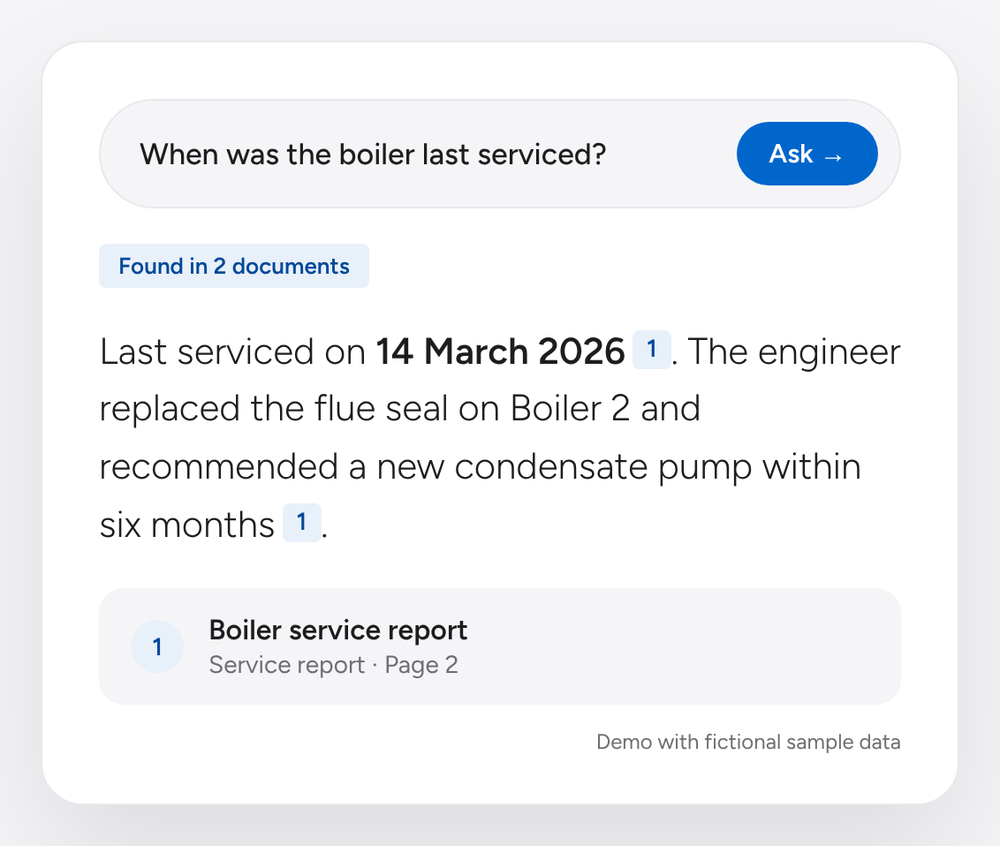
Much of what a fire risk assessment asks for is already in a building's files: alarm and emergency lighting service records, fire door surveys, previous assessments and their action plans, and the asbestos register. Building Search makes a building's documents searchable, so an assessor or manager can ask when the emergency lighting was last tested and see the document and exact page the answer came from. It doesn't carry out or replace a fire risk assessment. You can try the interactive demo, which uses fictional sample data.
Looking after several buildings' files? I'll send you a free one-page plan showing what a search page for one of your buildings would look like and what it would cost. See how Building Search works.
Questions people actually ask
Is there an official fire risk assessment template in the UK?
For England, GOV.UK publishes a free 5-step checklist with a fill-in form and an action plan, meant for the simplest premises. There's no single form the law requires everyone to use.
Does a fire risk assessment have to be in a particular format?
No set format is required, but it must be written down. Since 1 October 2023 every responsible person in England must record the assessment in full, with all its findings, plus their fire safety arrangements and the name of anyone who carried it out.
Is PAS 79 still used?
PAS 79-1 remains the reference for premises other than housing. For housing, BSI published BS 9792:2025 in August 2025 as a full revision of PAS 79-2. The Fire Industry Association offers the PAS 79 pro formas as free downloads.
What goes in a fire risk assessment action plan?
Each deficiency found, the action to fix it, a timescale and the person responsible. GOV.UK describes it as an inventory of actions, normally prioritised and with deadlines.
How often should a fire risk assessment be reviewed?
GOV.UK says to review it regularly and whenever there are significant changes, such as building work, a fire or near miss, or new dangerous substances, but it doesn't set a fixed interval. Keep a record of each review and its date.
Official guidance
- Fire safety risk assessment: 5-step checklist (Home Office, GOV.UK)
- Fire risk assessments (GOV.UK)
- Check your fire safety responsibilities under section 156 of the Building Safety Act 2022 (Home Office, GOV.UK)
- Residential PEEPs factsheet (Home Office, GOV.UK)
- Fire safety in purpose-built blocks of flats (GOV.UK)
- PAS 79 pro forma templates, free download (Fire Industry Association)