Every non-domestic premises in England, including the common parts of a block of flats, needs a fire risk assessment, and the law says exactly who is responsible for it. Here's who that is, what the assessment has to cover, and what has had to be written down since October 2023, summarised from GOV.UK guidance.
Before you rely on this: it's a plain-English summary of GOV.UK and Home Office guidance as it stood in October 2026, and it applies to England. It isn't legal advice, and a fire risk assessment should be carried out by a competent person. The official pages are listed at the end.
Fire risk assessment responsibilities at a glance
| Question | In short |
|---|---|
| Who is responsible? | The responsible person: the employer, owner, landlord, an occupier, or anyone else with control of the premises |
| In a block of flats? | For the common or shared areas, the landlord, freeholder or managing agent |
| What do they have to do? | Carry out a fire risk assessment, review it regularly, put fire safety measures in place and plan for an emergency |
| Does it have to be written down? | Yes. Since 1 October 2023, every responsible person must record the assessment in full, with all its findings |
| Can someone else do it? | Yes, but the responsible person stays responsible, and anyone appointed must be competent |
| How often to review it? | Regularly. GOV.UK doesn't set a fixed interval |
Who the responsible person is
The law behind this is the Regulatory Reform (Fire Safety) Order 2005, usually called the Fire Safety Order. It puts the duties on a "responsible person". GOV.UK says you're responsible for fire safety in business or other non-domestic premises if you're:
- an employer
- the owner
- the landlord
- an occupier
- anyone else with control of the premises, for example a facilities manager, building manager, managing agent or risk assessor.
The common areas of multi-occupied residential buildings count as non-domestic premises. For those common or shared areas, GOV.UK says the responsible person is the landlord, freeholder or managing agent.
What the responsible person has to do
GOV.UK lists the responsible person's duties as:
- carry out a fire risk assessment of the premises and review it regularly
- tell staff or their representatives about the risks identified
- put in place, and maintain, appropriate fire safety measures
- plan for an emergency
- provide staff information, fire safety instruction and training.
The guidance warns that you could be fined or go to prison if you don't follow fire safety regulations.
Fire risk assessment requirements: what it must cover
GOV.UK sets out the assessment in five steps:
- Identify the fire hazards.
- Identify people at risk.
- Evaluate, remove or reduce the risks.
- Record your findings, prepare an emergency plan and provide training.
- Review and update the fire risk assessment regularly.
For a ready-made structure to record it in, see the fire risk assessment template guide, which covers the free forms and the sections to include.
It also lists what you need to consider, including emergency routes and exits, fire detection and warning systems, firefighting equipment, the removal or safe storage of dangerous substances, an emergency evacuation plan, the needs of vulnerable people such as the elderly, young children or those with disabilities, information for the people on the premises, and staff fire safety training.
What has to be recorded since October 2023
Section 156 of the Building Safety Act 2022 changed the Fire Safety Order, and the changes came into force on 1 October 2023. Every responsible person must now:
- record the fire risk assessment in full, including all the findings
- record their fire safety arrangements, showing how fire safety is managed in the premises
- record the name of anyone they engage to carry out or review the assessment, and their organisation where applicable
- record and keep up to date their own contact details, including a UK-based address.
Where a building has two or more sets of domestic premises, such as a block of flats, the responsible person must also give residents fire safety information in a format they can easily understand, including the risks, the safety measures, and the responsible person's name and UK address.
Working with other responsible persons
A building can have more than one responsible person. The guidance says each must take reasonably practicable steps to identify the others, exchange names and UK addresses, record in writing the extent of each one's responsibilities, and coordinate their fire safety measures with the rest of the building.
When control of the premises changes hands, the outgoing responsible person must pass the relevant fire safety information to the incoming one, including the assessment and review records and the identity of the building's accountable person where known. In a high-rise residential building, the responsible person under the Fire Safety Order and the accountable person under the Building Safety Act are separate legal roles with separate duties, even where one organisation holds both.
Appointing someone to do the assessment
If you don't have the expertise or time, GOV.UK says to appoint a competent person to help, for example a professional risk assessor. The law says anyone you appoint to make or review the assessment must be competent; the guidance notes this particular requirement takes effect later, and recommends checking their training, experience or knowledge in the meantime. Your local fire and rescue authority can advise you, but it can't carry out the assessment for you.
Appointing someone doesn't move the responsibility. The duty stays with the responsible person.
Related checks in blocks of flats
In England, the Fire Safety (England) Regulations 2022 added specific duties for residential buildings with two or more sets of domestic premises, such as checking fire doors in buildings with storeys above 11 metres. They're covered in building records management, along with the records those checks create. For high-rise residential buildings, see the plain-English summary of the Building Safety Act and what counts as a higher-risk building.
Where Building Search fits
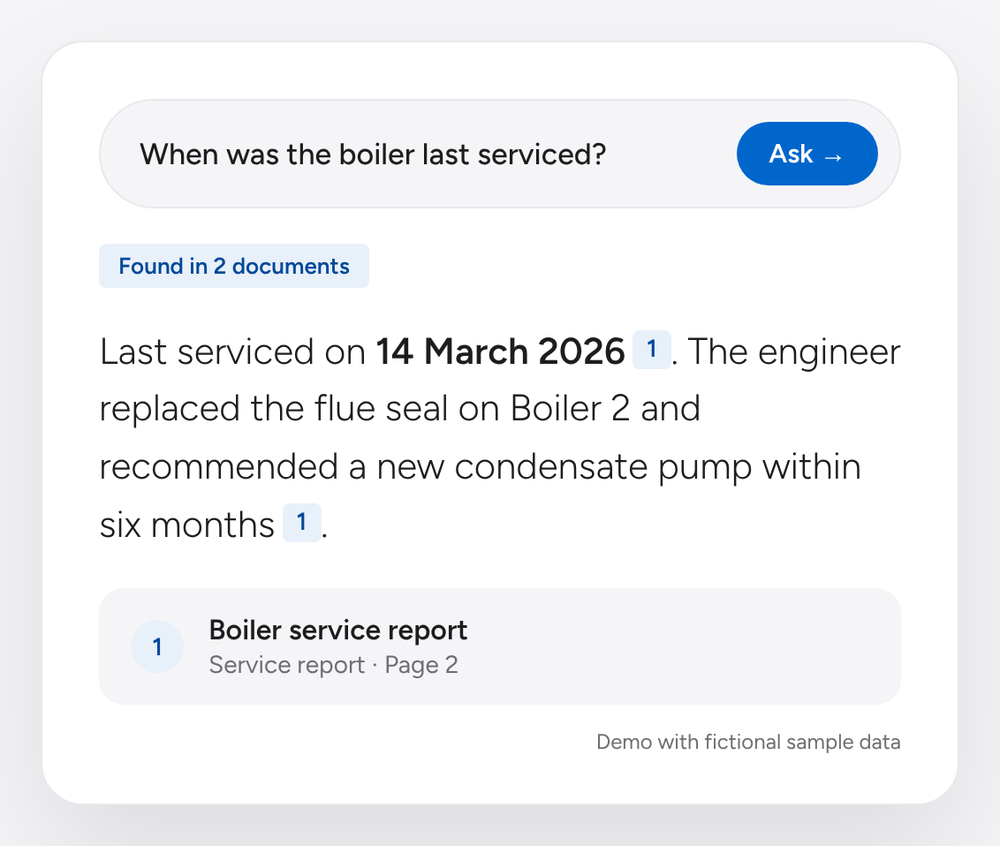
A fire risk assessment draws on evidence that's usually spread across a building's files: alarm and emergency lighting service records, fire door surveys, the asbestos register, previous assessments and their actions. Building Search makes a building's documents searchable, so you can ask when the fire alarm was last serviced and see the document and exact page the answer came from. It doesn't carry out or replace a fire risk assessment. You can try the interactive demo, which uses fictional sample data.
Looking after several buildings' files? I'll send you a free one-page plan showing what a search page for one of your buildings would look like and what it would cost. See how Building Search works.
Questions people actually ask
Who is responsible for making a fire risk assessment?
The responsible person under the Fire Safety Order: the employer, owner, landlord, an occupier, or anyone else with control of the premises, such as a facilities manager, building manager or managing agent.
Who is responsible for the fire risk assessment in a block of flats?
For the common or shared areas, GOV.UK says the responsible person is the landlord, freeholder or managing agent.
Does a fire risk assessment have to be written down?
Yes. Since 1 October 2023, every responsible person in England must record the fire risk assessment in full, with all its findings, along with their fire safety arrangements and the name of anyone they engaged to carry it out.
How often should a fire risk assessment be reviewed?
GOV.UK says to review and update it regularly, but it doesn't set a fixed interval. Changes to the building, its use or the people in it are good reasons to review it.
Can I do my own fire risk assessment?
You can if you have the expertise and time. If not, GOV.UK says to appoint a competent person to help, such as a professional risk assessor. The responsibility stays with you either way.
Official guidance
- Fire safety in the workplace: who's responsible (GOV.UK)
- Fire risk assessments (GOV.UK)
- Check your fire safety responsibilities under section 156 of the Building Safety Act 2022 (Home Office, GOV.UK)
- Fire safety: guidance for those with legal duties (GOV.UK)