New higher-risk buildings in England pass three checkpoints, known as gateways, before people can live in them: one at planning, one before building work starts and one at completion. Here's what happens at each, who's responsible and what gets checked, summarised from official guidance.
Before you rely on this: it's a plain-English summary of GOV.UK and Building Safety Regulator guidance as it stood in October 2026, and it applies to England. It isn't legal advice. The official pages are listed at the end, and they're the ones to check.
What the gateways are
The gateways are stop-go points for higher-risk buildings, introduced after Dame Judith Hackitt's review of building regulations and fire safety following the Grenfell Tower fire. Planning gateway one sits in the planning system. Gateways two and three sit in building control, which for higher-risk buildings is run by the Building Safety Regulator (BSR). BSR's current guidance calls them building control approval and the completion certificate, but they're still widely known as gateways two and three.
A higher-risk building has at least 7 storeys or is at least 18 metres high, and has at least 2 residential units, or is a hospital or a care home. Planning gateway one uses a slightly different definition, set out below. For the wider picture, there's a plain-English summary of the Building Safety Act.
Planning gateway one
Planning gateway one applies to planning applications made on or after 1 August 2021. It has two parts: the developer submits a fire statement with the planning application, and the Health and Safety Executive becomes a statutory consultee on those applications.
It applies to "relevant buildings": those containing two or more dwellings or educational accommodation, and 18 metres or more in height or 7 or more storeys.
The fire statement must be on the government's published form, or one to similar effect. Among other things, it covers:
- the fire safety principles, concepts and approach applied to each building
- the site layout
- emergency vehicle access and water supplies for firefighting
- any consultation on fire safety, and how it's been taken into account
- how local planning policies on fire safety have been considered.
The guidance says the statement should be focused, concise and proportionate to the scale, type and complexity of the development.
Gateway two: building control approval
Before any building work starts on a new higher-risk building, the client must get building control approval from BSR. The same applies to most building work on an existing higher-risk building, and to work that makes a building a higher-risk building or stops it being one. Carrying out building work without the required approval is a criminal offence.
BSR uses the application to check that:
- the proposed work will comply with building regulations
- the client will properly manage the project
- the people appointed to work on it are competent to do their job.
Unless an extension is agreed, BSR takes up to 12 weeks to assess an application for a new higher-risk building, and up to 8 weeks for work on an existing one. An application can be approved; approved with requirements, in which case work can't start on the parts that are subject to a requirement until BSR is satisfied it's been met; or rejected, for example if it doesn't have enough detail to show compliance.
The application documents include drawings and plans, a competence declaration, a construction control plan, a change control plan and log, a building regulations compliance statement, a fire and emergency file and a mandatory occurrence reporting plan, among others. Those documents become the start of the building's golden thread of information.
Gateway three: the completion certificate
When the work is finished, the client must apply to BSR for a completion certificate. A residential higher-risk building needs one before it can be registered, and it must be registered before anyone lives there.
With the application, the client uploads the latest versions of the agreed documents, such as the drawings and plans, construction control plan, change control plan, mandatory occurrence reporting plan, building regulations compliance statement and fire and emergency file. They also provide compliance declarations signed by each principal designer and principal contractor, a client confirmation statement, the change control log, and a signed statement that the building information has been handed over to the principal accountable person and, where applicable, the responsible person under the Fire Safety Order.
BSR assesses the documents, compares them with the original application, reviews the change log and inspects the completed work. If the building safety levy is payable, BSR can't issue the certificate until it's been confirmed that the levy is paid or that a valid notice of no charge has been issued.
What happens after gateway three
Once people live in the building, responsibility moves to the accountable persons. They register the building and give BSR its key building information, prepare a safety case report, and keep the golden thread up to date for the rest of the building's life.
Where Building Search fits
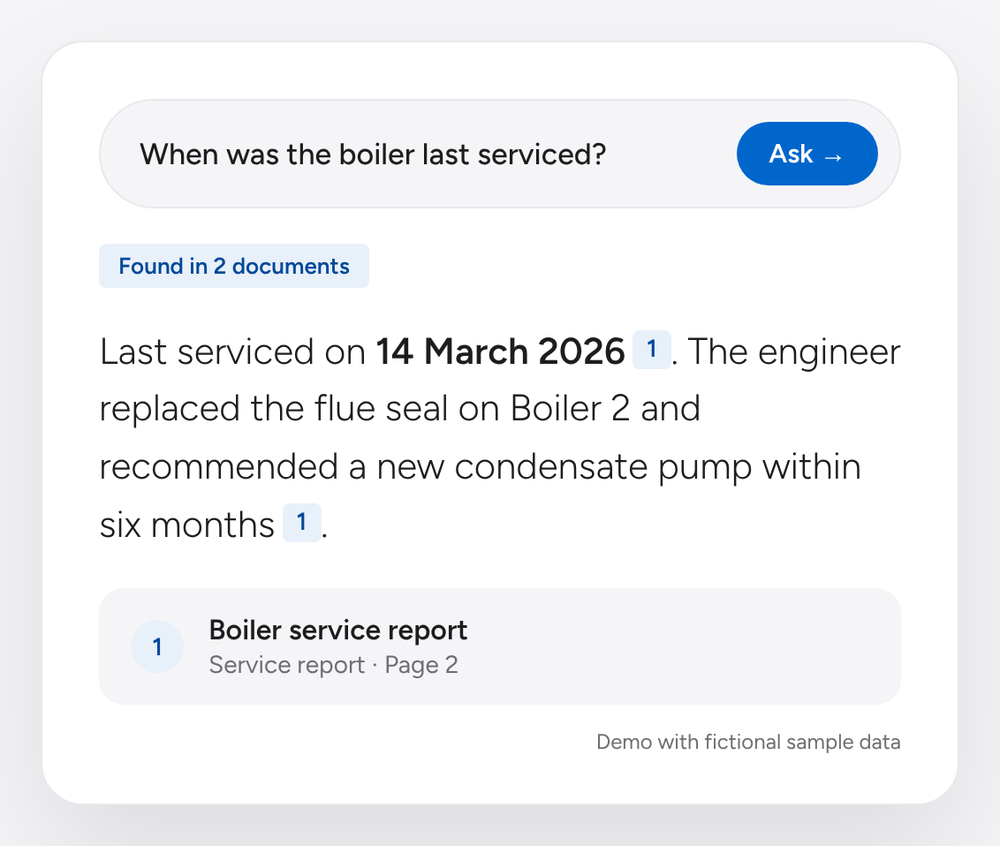
The gateways produce a large set of documents, and the people managing the building afterwards need to find things in them for years, alongside the O&M manuals and certificates. Building Search makes a building's files searchable and answers a plain question with the document and exact page each answer came from. It doesn't take part in the gateway process, and it doesn't make anyone compliant. You can try the interactive demo, which uses fictional sample data.
Looking after several buildings' files? I'll send you a free one-page plan showing what a search page for one of your buildings would look like and what it would cost. See how Building Search works.
Questions people actually ask
What are the three gateways in the Building Safety Act?
Planning gateway one, at the planning application stage; gateway two, building control approval from the Building Safety Regulator before building work starts; and gateway three, the completion certificate when the work is finished.
What is gateway 2 under the Building Safety Act?
It's building control approval from the Building Safety Regulator, which the client must have before building work starts on a higher-risk building. BSR takes up to 12 weeks to assess an application for a new higher-risk building, unless an extension is agreed.
What is gateway 3 under the Building Safety Act?
It's the completion certificate. The client applies for it when the work is finished, and BSR inspects the work and checks the documents. A residential higher-risk building needs one before it can be registered, and it must be registered before people live there.
What is planning gateway one?
Since 1 August 2021, planning applications for relevant high-rise residential buildings must include a fire statement, and the Health and Safety Executive is a statutory consultee on them.
Official guidance
- Fire safety and high-rise residential buildings (planning gateway one) (GOV.UK)
- Building control approval for higher-risk buildings (Building Safety Regulator, GOV.UK)
- Applying for a completion certificate (Building Safety Regulator, GOV.UK)
- Keeping information about a higher-risk building: the golden thread (Building Safety Regulator, GOV.UK)