The Building Safety Act says what a higher-risk building's golden thread of information has to be, not which software to keep it in. So before you buy a system, it helps to turn the regulator's requirements into questions for the supplier. Here's that checklist, in plain English.
Before you rely on this: the requirements are summarised from the Building Safety Regulator's golden thread guidance as it stood in October 2026, and they apply to England. It isn't legal advice, and it doesn't recommend any product. The official guidance is listed at the end.
What the guidance asks of the information
The government decided the golden thread must be kept digitally, although it can sit across more than one system. The guidance says the information must be:
| Requirement | What to ask a supplier |
|---|---|
| Kept digitally | Can every document type we hold be stored, including scans, drawings and spreadsheets? |
| Secure from unauthorised access | Who can see what, how is access controlled, and is there a record of who opened or changed a file? |
| Available when someone needs it | Can the right person reach it quickly, on site and out of hours, including in an emergency? |
| Presented in a way someone can use | Can a non-specialist find an answer without knowing which folder it's in? |
| The single source of truth | How do we stop duplicate or out-of-date copies, and how is the current version made obvious? |
| Accessible and in plain English | Can residents and other accountable persons be given what they're entitled to, in a simple format? |
| Compliant with data protection law | Where is the data stored, who processes it, and is there a data processing agreement? |
For what those requirements mean in full, and which buildings they cover, see the golden thread of information, explained.
During design and construction: version control
For building work on a higher-risk building, the client must provide a digital record-keeping system with version control, so anyone using it can see what changed. The principal designer keeps the design information up to date, and the principal contractor uses the client's system to keep the building information current. If you're buying for a project, ask:
- Does it keep every version of a document, and show who changed what and when?
- Can the principal designer and principal contractor work in it directly?
- Can it hold the documents prepared for building control approval, such as the construction control plan, change control plan and log, and the fire and emergency file? These are covered in the Building Safety Act gateways.
At handover: moving the information on
When the work is finished, the client hands the information to the principal accountable person, and the relevant fire safety information to the Responsible Person for any non-residential parts. Whoever receives it must confirm they have it and that it's in a format they can use. Later, when an accountable person stops being responsible for a building, they must pass the information they held to whoever takes over. So ask:
- Can the whole record be exported in standard formats, with its structure intact?
- What happens to our data if we leave the system, or the building changes hands?
- Can another organisation's system read what we export?
Once people live there: sharing and keeping it current
Accountable persons must provide building information on request to the Building Safety Regulator, to other accountable persons for the building, and to residents and owners of the flats. Where a building has more than one accountable person, each must share their golden thread information with the others. That gives three more questions:
- Can we share specific documents with a resident, the regulator or another accountable person, without opening up everything?
- Can several organisations contribute to one building's record?
- How are new documents, such as service reports and inspection records, added as they arrive?
The information also feeds the safety case report, which draws on the evidence behind it: surveys, risk assessments, inspection records and maintenance history.
Two things worth knowing before you buy
- It doesn't have to be one product. The information can sit across more than one system, as long as it meets the requirements above.
- Most of the information usually exists already. It's in a building's records, such as the O&M manuals, the health and safety file, surveys and certificates. The work is usually in organising it and keeping it current.
Where Building Search fits
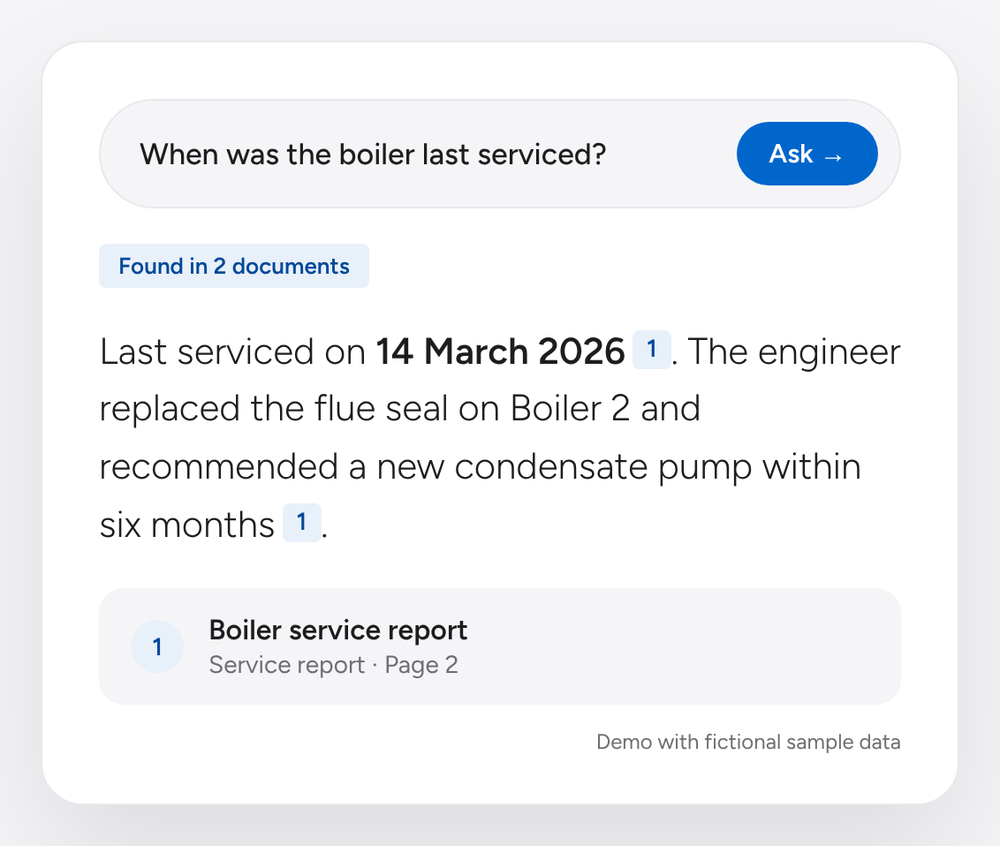
Building Search isn't a golden thread system and doesn't replace one. It sits on top of the files a building already has and answers a plain question, such as when the emergency lighting was last tested, with the document and exact page the answer came from. That helps with the "available when someone needs it" and "presented in a way someone can use" requirements for information you already hold. It doesn't make anyone compliant on its own. You can try the interactive demo, which uses fictional sample data.
Looking after several buildings' files? I'll send you a free one-page plan showing what a search page for one of your buildings would look like and what it would cost. See how Building Search works.
Questions people actually ask
What is golden thread software?
It's software for keeping a higher-risk building's golden thread of information: the digital, up-to-date record the Building Safety Act requires. The guidance sets requirements for the information, such as being secure, available and a single source of truth, rather than naming a product.
Does the golden thread have to be in one system?
No. The government decided the golden thread must be stored digitally, but it can sit across more than one system, as long as the information meets the requirements in the guidance.
What should golden thread software be able to do?
Keep the information digitally and securely, make it available when someone needs it in a usable form, act as the single source of truth, keep versions during building work, hand the information over in a format the recipient can use, and share specific information with residents, the regulator and other accountable persons.
Who is responsible for the golden thread?
During design and construction, the client, with the principal designer and principal contractor. Once people live in the building, the accountable persons, led by the principal accountable person.
Official guidance
- Keeping information about a higher-risk building: the golden thread (Building Safety Regulator, GOV.UK)
- Safety in high-rise residential buildings: accountable persons (Building Safety Regulator, GOV.UK)